






The Unbearable Weight of Conventional Delivery Economics
The math on traditional last-mile delivery simply doesn’t add up when scaled to the volume e-commerce demands. Human labor, while adaptable, comes with a fixed, non-negotiable upward cost trajectory. Think about it: drivers need wages, benefits, training, and time off. Every stop in a congested city center is a massive sunk cost of time spent navigating traffic, searching for elusive parking (drivers spend about 30% of their time on this in urban areas alone), and dealing with access protocols.
The Blended Pressure of Macroeconomic Headwinds
The economic squeeze has intensified dramatically. We’re not just battling rising domestic personnel costs; we’re fighting global instability. Since late 2024, the conversation around potential new, higher tariffs has introduced a crippling layer of cost uncertainty across the entire import and distribution spectrum. According to the National Retail Federation (NRF), past tariff hikes have already led to significant logistics cost increases for many companies, squeezing margins. If new, broader tariffs are implemented, the NRF has warned they could cost American families billions in lost spending power due to higher prices on necessities like apparel, footwear, and household goods.
This external shock meets an already strained internal labor market. Wage inflation means the historical cost advantage of manual delivery has evaporated. Companies are finding that the cost of failure is also crippling—a single missed delivery can cost a business around $17.78, leading to the fact that 84% of consumers won’t purchase from a brand again after just one negative delivery experience. The cumulative effect? We are being forced toward a different model, one where operational expenditure is predictable, scalable, and less susceptible to geopolitical maneuvering.
The Intelligent Fusion: AI as the Navigator for Physical Robots
The true differentiator in the new wave of last-mile automation isn’t the hardware itself—it’s the cognitive engine driving it. We’ve moved past simple, pre-programmed movement. Today’s physical delivery robots and drones are essentially mobile, distributed computing nodes powered by deep Artificial Intelligence and Machine Learning. These systems digest massive, real-time data streams—everything from evolving traffic patterns and weather shifts to specific residential access codes and historical delivery success rates—to formulate dynamic route plans that are impossible for human planners to match in granularity or speed.
This AI layer is the key to reliability. If a temporary road closure pops up, or a sudden micro-burst of rain hits, the intelligent agent adapts instantly, preserving the speed that consumers now take for granted. The power here is the self-optimizing network: every successful handoff refines the model for the entire fleet, creating a continuously improving logistical brain. This symbiotic relationship between AI and robotics is transforming what used to be a chaotic, human-variable process into a highly deterministic one.
The Technological Infiltration: Seeing the Robots on the Street and Sky
The shift is no longer theoretical; it’s visible on sidewalks and increasingly overhead. The technology rollout is happening across multiple vectors, each designed to solve a specific logistical bottleneck in the dense urban or sprawling suburban grid.. Find out more about How robotics mitigates rising last mile labor costs.
Sidewalk Sentinels: Autonomous Ground Vehicles and Delivery Bots
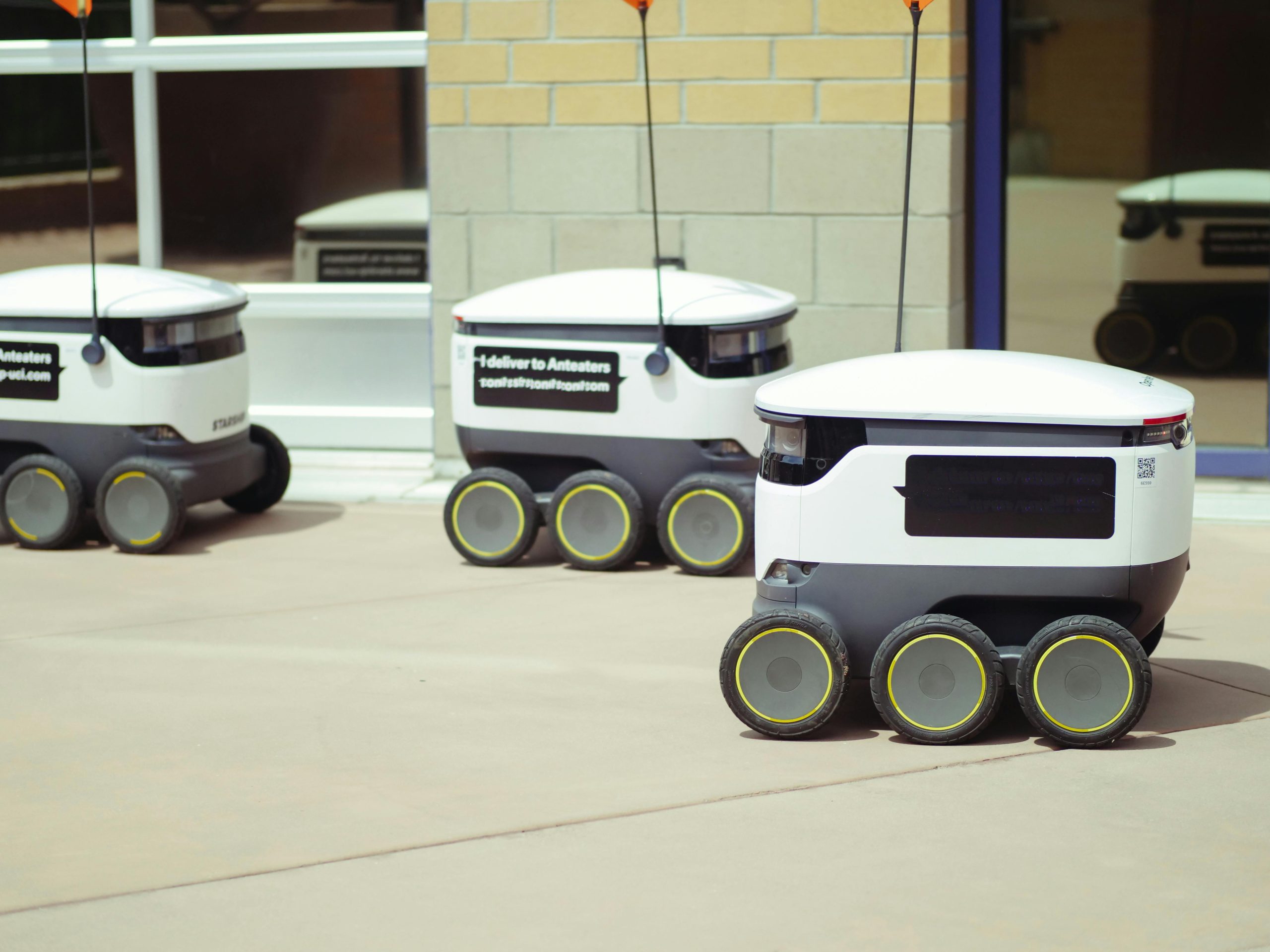
The most direct replacement for a human courier in many dense areas is the small, sidewalk-navigating delivery bot. These units are engineered for low-speed, short-distance hops, moving smaller parcels, groceries, or prepared meals. Their genius lies in their ability to ignore the vehicular gridlock entirely, utilizing pedestrian paths according to programmed right-of-way rules. They are quiet, emission-free, and don’t require the curb space a traditional van demands. Pilot programs across major metropolitan areas in 2025 are laser-focused on the trickiest part: sensor fusion in complex pedestrian zones—ensuring safety around unpredictable people, pets, and street furniture. Companies like Serve Robotics, which recently acquired Vayu Robotics to boost its AI navigation in the US, are making serious headway, with new models appearing in major city tests.
The Third Dimension: Aerial Drone Logistics for Extreme Speed
To conquer congestion, systems are utilizing the sky. Modern delivery drones have shed the “toy” image of early prototypes. Thanks to improvements in battery energy density and advanced hybrid VTOL (Vertical Take-Off and Landing) airframes, these vehicles now offer longer flight times and greater payload capacity, moving them from experimental curiosity to serious tools for specific missions.
For scenarios demanding extreme velocity—think emergency medical supplies or high-value, time-sensitive components—drones are unmatched, delivering in minutes instead of hours. The technological maturation is evident in the real-world expansion: Walmart and Zipline, for example, are already running significant operations across the Dallas/Fort Worth area in Texas as of November 2025, proving out the model for rapid dispatch from retail locations. The focus now is on achieving robust, all-weather capability and ensuring foolproof, secure payload drop-offs, all governed by centralized AI control towers managing low-altitude air corridors.
The Internal Engine: Automated Sorting and Micro-Fulfillment Centers
It doesn’t matter how fast your drone is if the package takes three days to get from the shelf to the loading dock. Automation must start at the source. The industry is rapidly evolving past massive, distant distribution centers toward a network of smaller, highly automated micro-fulfillment centers (MFCs) embedded directly within population centers.
Inside these MFCs, the speed is breathtaking. High-density robotic storage and retrieval systems (AS/RS) work alongside AI-guided picking arms. The overarching AI prioritizes orders based on tight delivery deadlines—like that sub-hour promise—minimizing the travel distance for the hardware. By compressing the order-to-dispatch time, these centers ensure that the expensive autonomous fleet assets are maximized for their highest-value function: driving down the cost of the final mile. This internal speed directly contributes to the overall cost-reduction strategy.
Navigating the Hurdles to True Ubiquity. Find out more about How robotics mitigates rising last mile labor costs guide.
If the technology is this compelling, why aren’t these robots everywhere? Widespread adoption is currently snagged by a few significant non-engineering challenges. Until these are resolved, you’ll see heavily piloted programs rather than fully unsupervised, city-wide fleets.
The Maze of Regulatory Frameworks and Airspace Governance
Perhaps the slowest gear in this high-speed machine is the regulatory body. Governments worldwide are playing catch-up, trying to safely integrate thousands of low-altitude, autonomous vehicles into airspace currently managed for manned aircraft. Establishing standardized certification for the reliability of AI-driven navigation is inherently slow; public safety trumps commercial expediency every time. Furthermore, liability rules in the event of an accident—who pays when an autonomous carrier makes a mistake?—are still being codified in courts and legislatures. A clear, unified regulatory framework defining operational boundaries, maintenance standards, and mandatory reporting is the missing blueprint for true, scalable deployment.
The Unseen Threat: Cybersecurity in Distributed Networks
Every sensor, every antenna, and every line of code in an autonomous fleet creates a new point of vulnerability. A distributed network of delivery robots is a massive, appealing attack surface for bad actors. A security breach could mean anything from stolen customer delivery data to the worst-case scenario: the physical hijacking or weaponization of a fleet of autonomous carriers. Consequently, investment in security—robust, end-to-end encryption, continuous intrusion detection, and secure over-the-air updates—is not a feature, it’s the foundation. The network must be self-healing and able to isolate threats without crashing the entire service.
The Dexterity Gap: Technical Limitations in Package Handoff
Robots are incredible at programmed, repetitive motion inside a climate-controlled warehouse. They are far less adept at nuanced, unpredictable human interaction. The final transfer—the handoff—remains a surprisingly complex problem. Consider the variables: inconsistent porch lighting, an oddly shaped package, or a precarious placement on a doorstep railing. Current robotic grippers lack the fine motor control and tactile sensing of a human hand to assess if a package will fall over once placed. Overcoming this ‘dexterity gap’ requires major breakthroughs in tactile sensing and advanced learning models that allow the robot to truly *feel* and assess stability, a hurdle that still requires a human to perform the final, delicate placement in many complex service scenarios.
The Hard Numbers: Economic Rationale and Return on Investment
The primary motivator for this entire technological shift is financial. The cost structure of the old way is simply too high to absorb in the long run, especially with the volatility of global trade. The new model promises a fundamental restructuring of the cost-per-delivery equation.. Find out more about How robotics mitigates rising last mile labor costs tips.
Modeling the Long-Term Cost Decline
Yes, the initial Capital Expenditure (CapEx) for a sophisticated fleet of autonomous assets is massive. Payback periods look long on paper. However, the projections for the next decade are compelling. As production volumes for specialized batteries, sensors, and processors ramp up—a trend already accelerating in 2025—the per-unit hardware cost is set to drop sharply.
Once these systems move from pilot programs to 24/7, multi-shift operations, the internal rate of return shifts dramatically. Financial analysts suggest that within ten years, the fully loaded cost per delivery by an autonomous system—stripping out the escalating variable cost of human labor—could be a fraction of the manual rate. The investment is becoming less a matter of competitive edge and more a necessity to *achieve* a viable cost-per-drop.
Decoupling from the Labor Cost Escalator
The leverage point is clear: robotics allows companies to **decouple delivery cost from human wage inflation**. Operational expenses shift from a variable cost (wages) to a fixed, depreciable capital asset (the robots and software). Even in hybrid models where humans handle exceptions, the human workforce is re-tasked to its highest value-add activities, reducing overall dependency on low-efficiency, high-cost labor inputs.
The Added Value of Perfect Precision
Automation doesn’t just deliver cheaper; it delivers better, and that generates its own ROI. Automated, AI-driven routing drastically minimizes the most expensive variable: the missed delivery. With precise GPS and machine vision confirmation, first-attempt success rates climb far above manual benchmarks. This reduction in ‘exception volume’ means fewer costly return trips and, critically, fewer calls to overwhelmed customer service centers. That operational friction reduction—that increased reliability—is a tangible financial benefit that offsets the initial technology investment.
Systemic Reorganization: Reshaping the Physical Grid
The final mile revolution isn’t just about the vehicle; it’s about where the vehicle starts its journey. Automation requires a complete rethinking of the physical logistics infrastructure.
From Mega-Hubs to Decentralized Networks. Find out more about learn about How robotics mitigates rising last mile labor costs overview.
The era of relying solely on massive distribution centers hundreds of miles away is over. The optimal strategy now requires a dense network of smaller, highly automated micro-fulfillment centers located strategically within city limits. This decentralization minimizes the distance the autonomous ground units or drones travel, ensuring the most expensive segment—the last mile—is as short and predictable as possible. We are seeing this manifest in repurposed retail backrooms and modular fulfillment pods being established to prepare orders immediately before autonomous dispatch.
Collaborative Delivery and Asset Sharing Models
To further optimize the massive capital outlay required for an autonomous fleet, collaboration is becoming the norm. Sophisticated software platforms are enabling competitors—or non-competing partners—to share fleet capacity during peak demands. Imagine a shared drone network handling aerial deliveries for multiple e-tailers in a defined zone. This “shared utility” model ensures the expensive hardware is operating near full capacity rather than sitting idle awaiting a low-volume order from a single provider. This fosters a more resilient and capital-efficient ecosystem for everyone involved.
The Upskilling of the Human Workforce
Let’s be clear: automation isn’t eliminating the workforce; it’s undergoing a severe, rapid redefinition. The human role is shifting away from monotonous driving and physical handling toward higher-level cognitive and supervisory functions. The new logistics professional is a:
This transition demands significant, proactive investment in large-scale workforce upskilling and retraining initiatives. The new value is in technical proficiency and critical thinking, not just endurance.
The Autonomous Future of the Consumer Experience
The technology push isn’t just saving money for the companies; it’s fundamentally changing the service contract with the consumer. The expectation bar is climbing higher, faster, and technology is the only tool capable of meeting that demand while remaining profitable.
Hyper-Flexibility and Contactless Modalities
Robotics facilitates a dizzying array of delivery options far beyond “doorstep or nothing.” We are seeing the proliferation of secure smart locker networks accessible via digital keys, coordinated neighborhood delivery hubs, and even secure in-garage interfaces for autonomous vehicles. The core advantage is the ability to execute complex, multi-step, contactless handoffs with built-in security protocols, essentially adapting the delivery system to the customer’s varied lifestyle—from dense apartment living to isolated rural addresses.
Visibility and Real-Time Communication
The promise of speed must be backed by absolute transparency. The passive “Your package will arrive between 1 PM and 5 PM” notification is obsolete. Consumers in 2025 demand granular, real-time tracking that mirrors the automated system’s precision. This means live GPS plotting of the delivery bot’s location, proactive alerts for even minor deviations, and instant confirmation of secure placement. The AI must manage this information flow proactively, creating a transparent journey narrative that builds consumer trust in the automated delivery process.
Sustainability: The Inherent Green Dividend
One of the most welcome side effects of this necessary automation shift is the immediate alignment with corporate social responsibility. Last-mile delivery, historically a major source of urban carbon emissions from idling diesel vans, can transition to a near-zero-emission operation when executed by electric-powered autonomous ground vehicles and drones utilizing AI-optimized, minimal-distance routes. For many consumers today, the environmental profile of a purchase is a key factor in brand selection. Thus, the ability to market a ‘Zero-Emission Final Leg’ is becoming a powerful, differentiating service offering, turning a required technological upgrade into an ethical advantage.. Find out more about Cybersecurity risks in autonomous last mile fleet management insights guide.
Actionable Takeaways for Navigating the Shift
The crisis in the final mile is real, but the response is clear. This is not a moment for hesitation. Here are the key actions for any organization involved in product fulfillment:
The trajectory is set: last-mile logistics is rapidly transforming into a fully integrated, lights-out operation supported by advanced robotics and AI. While regulatory and dexterity hurdles remain, the economic pressure from tariffs and labor inflation makes the shift from human-centric to machine-centric an economic inevitability. The future of competitive commerce will be won or lost in the few miles between the distribution hub and the customer’s doorstep. The technology is here; the only remaining variable is how quickly your organization decides to embrace the necessary transformation.
What is the single biggest operational bottleneck in your local final-leg fulfillment today? Share your thoughts in the comments below—let’s discuss the practical next steps!



